When you arrive at Kaohsiung airport, you’re greeted with a sign on the exit doors saying:
PLEASE AVOID THE COLLISION
This should have stood as a warning as I came to Taiwan in the hope of helping people perfect their English.
Taiwanese rely on translation and take a very lexical approach to language. However, English is not Chinese. Words are ideas and many of the ideas are often fundamentally different. For example:
In Chinese “guan xie” means relationship but also the larger network of inter-relationships; so the Australian expression “no worries” has the Taiwanese equivalent of “may yo guan xie” which is literally translated as “no have relationship or personal debt”.
This approach to language learning is reiterated in the education system, which relies on constant tests of vocabulary and spelling. Students go through their whole life trying to put things they say in Chinese straight into English. Therefore when I’m checking writing I’ll often come across amazing combinations of words like:
“If you enjoy the hubbub of the voice place, go to Urban Spot Light”
or
“your daughter should consider the bright future”
The use and overuse of electronic dictionaries also leads to some amazingly archaic vocabulary. One of my students really enjoys gourmandising another has sanguine walls.
Bad English can even be found in government buildings and on websites. I went to the department of motor vehicles and had to stand in the cue marked:
I find it a little frustrating as I know everyone under about 30 has had at least 5 years of English language instruction. Yet asking for a coffee at the coffee shop (which is ka-fe in Chinese – not a huge linguistic stretch) is met with fear, consternation, and running to find the English speaker.
I know I should be working harder at learning Chinese but after four years in three different countries, I’m suffering from language fatigue. There’s also something comforting about not knowing what anyone around you is saying.
These irregularities of English often give me a chuckle but can also be powerfully disheartening when teaching.
I can't pretend I know too much about architecture but I can tell you what I like. I have to admit there isn't too much architectural inspiration in Taiwanese cities.
When the Dutch arrived in the 16th century they dubbed the place "Ilha Formosa" or "Beautiful Island". Well we have a pretty good demonstration of what not to do with a beautiful island.
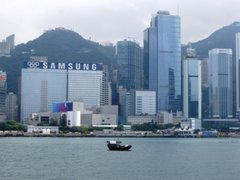
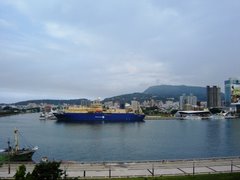
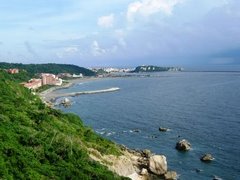
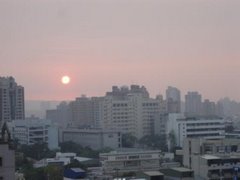
View from the top of Dream Mall looking toward the harbour.
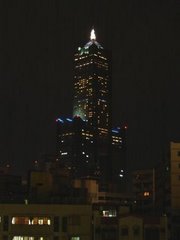
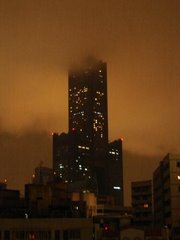
The Taiwanese love their big buildings. They're very proud of the Taipei 101, the tallest building in the world (for a short time). Koahsiung's 85 holds similar awe.
The majority of buildings that people live in though are concrete cubes with weird wiring and poor insulation - hot in summer and cold in winter.
Overall I find them grey and depressing. One of my students, who is an architect, says these pre-fabs are cheap to build.
The seventies styles seem common.
Government buildings are not immune.
This one is amazing if only for the tree growing through it.
Even the new ones look soulless. You must have air conditioning or they're unbearable.
“Benjamin Wang (王星威), president of Chun Shin Limited and an English Testing System representative in Taiwan, said a TOEIC score of 750 was required to be able to teach English using only the English language and text books in English.
He said that this was much higher than the teacher’s average of 539 in Taiwan.”
Cram schools or "buxibans" are big business here. Common topics include English and maths. Most of the people I know in Taiwan are buxiban teachers. I did it for about six months and then went in search of an adult school. It’s a good thing I did, as Taiwan would have fewer children now, if I’d continued.
It’s not the children that would've caused me to rip off their heads, but the system to which they are subjected. It's glorified baby sitting with an emphasis on: making money, placating parents, daily spelling quizzes and making the students come back for the next course, to make more money. The place I worked at linked my pay raises to the number of students who returned for the next course. More about them later.
Message from someone in charge at a buxiban in Kaohsiung, I shit you not
They generally start at 4pm and most don’t finish until 9.30 at night. These kids go straight from school to buxiban to doing homework –they only get about five or six hours sleep and then expected to achieve academic excellence. It’s ridiculous.
The English cram schools rely on Chinese teachers to do the bulk of the teaching. Flair play, they do a pretty good job under the circumstances and get paid about half the amount that foreign teachers get. They are also expected to work for free, clean the school and do all the marking, in a lot of cases.
At the same time, expecting them to teach pronunciation is pretty unreasonable, when many of them I met have never been to an English speaking country. This is not too much of a problem, as from what I’ve seen, they teach mostly in Chinese. This goes against most of what I’ve been taught in regards to second language acquisition.
Mind you, I’ve been trained to teach English as a Second Language, which is better than most of the foreign teachers in Taiwan. All you need here is a degree, or at least two years of tertiary education. Taiwan has the lowest standards for English teachers I’ve experienced in four countries. Even Thailand, where they pay about a third of the wages here, expect more from their teachers.
It shows too. A larger collection of fresh-out-of-college Americans paying off their student loans would be hard to find anywhere else in the world. The numerous foreigner bars (mostly run by recovering teachers who’ve stayed too long and have to get out of teaching before they go insane) are filled nightly with bad facial hair, backwards baseball caps and inane babble.
Heaven help you if you’re a native English speaking Asian. Despite having the same passport, education and language skills as your Caucasian counterparts, the school will try to pay you a local teacher’s salary, on the grounds that parents don’t expect Asian native speakers – or at least that’s the story I’ve heard from a few people.
Parents don’t want dedicated educators, they want white monkeys to dance in front of their children in the hope they will better pass ludicrous vocabulary tests.
This has led, in part, to the deplorable state of English in Taiwan.
“There is a palace of gold in a book” -Chinese proverb
Education in Taiwan is very important. For 1300 years during Imperial Chinese rule, you had to memorise the works of Confucius and pass a lengthy examination if you wanted to get into the civil service. This was a well paid job that you held for life. Needless to say, only the moneyed elite had the opportunity sit around rote learning 20 books.
The legacy of this system permeates the modern Taiwanese education structure. Great emphasis is put on students passing exams, as this is seen as the only way to find security in later life. Cases of students being beaten for bad grades are common and they teen suicide rate is through the roof.
School
With this in mind, it is surprising that children in Taiwan only go to school for half days until they are nine. After that, things get a little more hectic. Classes can have as many as 50 students and are based on the “chalk and talk” method of teaching – I speak, you listen and regurgitate my thoughts on demand. It’s all rote learning.
Having “ideas” is not generally encouraged. Exams and quizzes are so common you’d think they would become meaningless. Classes start at 7.30 am and finish at 4 pm. Many of the students I speak to aren’t allowed to watch TV, use the internet or have any interests outside studying. With all the importance of academic achievement, it is no surprise that many students enrol in extra classes after school: buxibans.
Students also clean the school. I like this idea as you’re less likely to make a mess if you have to keep the place clean.
University
At the end of high school, there is one final examination that will determine your whole future, or so it is presented – The University Entrance Exam. This will decide what courses they can study. What you can study is often dictated by parents as well. I can’t tell you how many times I’ve met young girls studying engineering, who seem to have almost no interest in the topic. The tragedy is compounded when I meet middle aged people with jobs they hate.
Oddly enough they best universities are the public institutions; while private schools are for the rich, thick kids. Some universities are set up by large corporations to mould their employees of the future.
Everything foreign in Taiwan is considered worthy. Students are no exception. Over the past few years the government has been offering huge grants for students to come and study for an MBA for free. Classes are mostly in English but the quality of the course (and the English) is yet to be seen.
Military service is compulsory in Taiwan for males after they leave study. Therefore, it seems many male students go onto further study, just to avoid going to the army.
Later Life
What is the result of all this education based on rote learning and memorisation?
A nation without imagination
Independent thinking is not encouraged, and although hard working, something extra will be required to take this economy to the next level, like those of Japan or Korea.
You look at biggest industries in Taiwan and they don’t produce anything original but reproduce cheaper versions of other people’s ideas: semiconductors, bicycles and Asus computers. With China having a huge pool of slave labour, the Taiwanese are going to find it hard to compete unless they can find something that no one else does better.
You still need to pass a huge exam to get into the civil service.
Unfortunately, I wasn't able to get photos for all the bad fashion I see around me, so here's a list I jotted down while sitting in cafe near Wufu Road.
Recently, I’ve come to the conclusion that I’m not going to die anytime soon. This is a mixed blessing. On one hand, being alive is a lot more fun than being dead (as far as we know anyway – the dead people I’ve met, never seem to be enjoying themselves). On the other hand, if you’ve made the decision that you are going to live, you should work towards ensuring that your life is going to have some sort of quality. For this reason, I’ve decided to exercise.
The other solution would be to give up the smoking, drinking and deep-fried foods. This is not an option in the short term. Exercise it is then.
I don’t like sports. Gyms are full of muscle-bound narcissists in tiny shorts. I have bad knees, so abhor running – if you ever see me running, follow me, as there’s something nasty coming. I’ve always enjoyed swimming though, so this is my exercise of choice.
The week I was born, a swimming pool was installed at my family home. There is some debate as to whether my siblings were more excited by me or the pool: the consensus lies with the pool. I’m told I could swim before I could walk, and even today, feel more at home in water than on land.
Growing up in Australia, where 90% of the population live near the ocean, swimming lessons are mandatory. There were school swimming competitions and Sunday mornings at the beach with the boogie-board.
It was interesting moving to Taiwan, another island nation, to find the majority of people I speak to can’t swim. I observed this in Thailand as well. There are swimming pools however, which are fairly well populated.
The first thing you notice about a Taiwanese swimming pool is the uniform. No boardies here: budgie smugglers, banana hammocks and dick slickers, as far as the eye can see; complimented by a compulsory, and usually matching, swim-cap.
It’s good to see people who are so comfortable with their bodies that they are willing to run around in their underwear. I’ve never been too much of a fan, but at the same time, I don’t have to look at myself. It’s either this, or die sooner rather than later.
N-Spa
Why the love of the leotard? One of my friends is convinced it’s for public hygiene: it keeps unwanted hair out of the filters. Fair enough for those of Asian decent. Personally, I have more hair on my face than most Taiwanese men have down their trunks, and the friend in question has more hair on his back, than could be found on the entire Taiwanese rugby team (if there was one).
Whatever. As with most stupid rules, I don’t make them, but I’ll follow them if it makes life easier. I donned the apparel and drove in. A quick 25 laps and…
…stop. A pair of legs in front of me. I stand up and see everyone is swimming breast stroke, at about one kilometre a day.
What can you do? I swam under them and kept going. Eventually, I developed a system of only choosing a lane with one other person then waiting for them to get half way towards me before taking off at a swift free-style. I make it to the end before they finish a length. Then I have a nice rest while they take their sweet time coming back towards me. Seeing the giant hairy foreigner streaking past them, is enough to make most Taiwanese people decide to swim elsewhere, and I get the lane to myself.
Breast-stroke seems universal, except for one group of chaps, who can occasionally be found doing bad butterfly impressions down the centre lane and creating miniature tsunamis that make it impossible for anyone else to use the pool.
At least they give it a bash. For most people, swimming is a mystery. “Spas” are quite popular though. I’ve spent many a hangover relaxing in the variously-coloured therapeutic pools and under massaging water jets at N-Spa. For a 250 NTD day pass they offer: an underused Olympic sized swimming pool, saunas, steam rooms, hot pools, cold pools, bubble seats and deck chairs.
Most people are there to sit in tepid pools of water, rather than to swim. Noticeably the elderly as well: is this why they live so long?
N-Spa
There is also a ubiquitous fear of the ocean.Every beach I’ve been to in Taiwan has signs saying: “No Swimming, Strong current”. This is true, it’s easy to get swept from shore, but with a few simple precautions there’s minimal danger. If you’re at a beach in Kaohsiung, you’re more at risk of heavy-metal poisoning.
God help you if there’s a life guard on duty and you go in past your knees. He will be riding his ATV across the sand, blowing his whistle, yelling and tossing his ciggie butt on the sand, quicker than you can say: “Littering is a crime you arse-hole!”.
This seems fine for most Taiwanese people. The concept of getting ready to get in the drink involves rolling up trouser legs. The braver souls can be seen inflating their adult-sized arm bands and floating devices, before venturing in to the waist.
Off for a swim
We were recently on Green Island, which would have to rank in my top five places to visit in Taiwan. The snorkelling was amazing; such a plethora of tropical fish. Local tour operators run “snorkelling adventures”. It would have to be one of the funniest things I’ve ever seen. Picture: 20-30 people wearing full-length wetsuits, booties, life-vests, masks, carrying life-preservers and being pulled over three meters of water on a rope by a tour guide. Hilarious.
Taiwanese on a rope
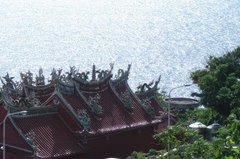
The cultural fear of the ocean is deeply ingrained. Mazu, Goddess of the Sea, is one of the most popular deities on this tiny island. There’s about 1,000 temples dedicated to her worship.Right now we are in “ghost month” when spirits rise from the underworld. Anyone in the ocean is liable to pulled to a watery death.
Mazu
Personally, I fear death by lack of exercise or execution for the murder of slow swimmers, rather than angry maritime ancestors. Either way, you have to die sometime. For now, I will keep up with the swimming, in the hope of extending my life just a little longer.