
Showing posts with label Photos. Show all posts
Showing posts with label Photos. Show all posts
Thursday, 9 October 2008


Friday, 3 October 2008

Dog Training
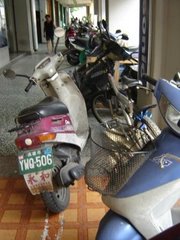
If you own a dog in Taiwan, you will have to train it to ride on your scooter.
I parked my bike one night and this guy wanted to go for a ride
I parked my bike one night and this guy wanted to go for a ride

Wednesday, 1 October 2008
Green Island
Here's my belated photo-essay from Green Island.
It ranks among my top place to see in Taiwan.
It ranks among my top place to see in Taiwan.

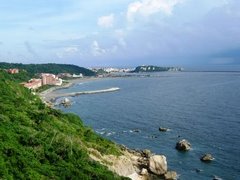
I'm going to focus here on the natural beauty of the place,
and too much on our endeavours,
or the events that led to Roisin's injuries.

These are some of my favourite signs


The beaches are not all that great for swimming
but once you get past the rocks the fish are awesome.
but once you get past the rocks the fish are awesome.


Oh deer! Does anyone else see anything wrong with this?

And here some more pics of those crazy guys out "snorkelling"
Wednesday, 13 August 2008
Foguanshan
This is a big temple, about half an hours drive out of Kaohsiung.
If you drive out towards Maolin National Park, you won't be able to miss the giant golden statue on the hill:

It would be easy to spend a whole day wandering around but we did the shortened tour on a Saturday afternoon.
Must see-s include the Gates:

Off to one side there's a weird tunnel walkway explaining the path to enlightenment, the Buddhist deities and the original cast of the temple:


Then head onto the main temple:

where you'll find three giant golden Buddha statues:

The room is lined with thousands of tiny Buddha statues:
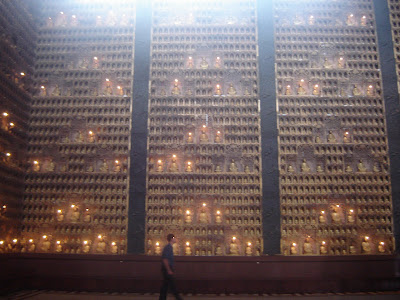
It's really quite impressive:

Then head over to check out the view at the big Buddha statue that looks out over the country side:


An guess what, there's a few more Buddha statues:

I'm sure there's more going on than just statues. There's some great gardens and it looked as if they run retreats for foreigners as well.
So, if you've got some spare time around Kaohsiung county, check out Foguanshan. It's worth a visit.
If you drive out towards Maolin National Park, you won't be able to miss the giant golden statue on the hill:

It would be easy to spend a whole day wandering around but we did the shortened tour on a Saturday afternoon.
Must see-s include the Gates:

Off to one side there's a weird tunnel walkway explaining the path to enlightenment, the Buddhist deities and the original cast of the temple:


Then head onto the main temple:

where you'll find three giant golden Buddha statues:

The room is lined with thousands of tiny Buddha statues:

It's really quite impressive:

Then head over to check out the view at the big Buddha statue that looks out over the country side:


An guess what, there's a few more Buddha statues:

I'm sure there's more going on than just statues. There's some great gardens and it looked as if they run retreats for foreigners as well.
So, if you've got some spare time around Kaohsiung county, check out Foguanshan. It's worth a visit.
Monday, 21 July 2008
Funky Frog Food
I've just got back from dinner with my students and had an experience that has to be shared.
These students, over the past month, have taken great pleasure in shouting me "2nd dinner" after class. They are always ordering stuff they think will make my stomach turn.
So far I have consistently disappointed them, by eating what ever they put in front of me.
The first week it was pig's blood pudding. That was nothing, it tastes a bit like liver.
 Photo from Jas
The next week it was "four gods soup". Apparently all four gods take the form of intestines. Bah humbug, I had plenty of that in Thailand. They say it's good for you but it tastes as good as it sounds.
It was served as a side dish to a collection of delicacies including pig skin. I'm quite fond of pig skin - usually roasted and glazed with brown sugar; also known as "crackling". This pig skin however, seemed to have been boiled and reminded me of undercooked crackling. It was fine, the little hairs threw me a little though.
This week though it was frog. The direct translation from Taiwanese is "field chicken" which is pretty accurate, it tasted a lot like chicken.
It was just looking at the leg, dangling from the end of my chopsticks, that made me feel a bit cautious. All I could think of was "Kermit the Frog". The skin had this amazing colour: black with grey spots.
It was so... frog like.
You get that I suppose.
Anyway, it was another string to my culinary bow.
You never know until you give it a go.
Well, I have,
and if you don't want to:
the answer is - it tastes like chicken.
Quite tasty really.

Photo from here
These students, over the past month, have taken great pleasure in shouting me "2nd dinner" after class. They are always ordering stuff they think will make my stomach turn.
So far I have consistently disappointed them, by eating what ever they put in front of me.
The first week it was pig's blood pudding. That was nothing, it tastes a bit like liver.
 Photo from Jas
The next week it was "four gods soup". Apparently all four gods take the form of intestines. Bah humbug, I had plenty of that in Thailand. They say it's good for you but it tastes as good as it sounds.
It was served as a side dish to a collection of delicacies including pig skin. I'm quite fond of pig skin - usually roasted and glazed with brown sugar; also known as "crackling". This pig skin however, seemed to have been boiled and reminded me of undercooked crackling. It was fine, the little hairs threw me a little though.
This week though it was frog. The direct translation from Taiwanese is "field chicken" which is pretty accurate, it tasted a lot like chicken.
It was just looking at the leg, dangling from the end of my chopsticks, that made me feel a bit cautious. All I could think of was "Kermit the Frog". The skin had this amazing colour: black with grey spots.
It was so... frog like.
You get that I suppose.
Anyway, it was another string to my culinary bow.
You never know until you give it a go.
Well, I have,
and if you don't want to:
the answer is - it tastes like chicken.
Quite tasty really.

Photo from here
Sunday, 8 June 2008
Dragon Boat 08

Last year I gave you some background on the traditions of the Dragon Boat Festival.
This year, we've gone one better and can report from the inside, as a rower in a dragon boat team.
Getting it organised was easier said than done, our team were all foreigners, who are notoriously alcoholic and unreliable. Fortunately we had Rose to get it all together.
TECHNIQUE:
There are two types of dragon boat: one small and seek, the other large, cumbersome and colourful. The latter was the one we had. There are 22 people in a team with one person steering, one drumming and one to grab the flag.
 First thing you need to do is get going. To do this you paddle quick, shallow and fast for twenty strokes or so. Then move into the long, deep, slow strokes, that take you to the finish. You pull with your back by leaning forward, not with your arms and in time with your team, dipping your oar as you hear the drum beat.
TRAINING:
This began two weeks before the event. Down by the river the local government set up pontoons with all the boats moored alongside and a little marquee. We had about a dozen dates booked, but because of everyone's schedules, we never had a full compliment at any one session.

All sessions were scheduled for early morning (by Xpat standards) at ten, so there were many bleary eyes and weary limbs. We soldiered on as best we could.
Our usual hour training: pull the boat out, do a start and twenty strokes then rest for about five minutes. This would be repeated three or four times, then it was time to start heading back and go out for breakfast.
COMPETITION:
There was another team of foreigners sponsored by one of the local gyms. Their training began six weeks before the race and included running, rowing machine practice and getting started in the middle of the night (6am). These guys were seriously chasing the 300, 000 NTD in prize money.
Our team was sponsored by a local bar / bbq place and we were chasing the free beer at the end of the race.
Other teams chanted: Ji-yo, Ji-yo, Ji-yo (go, go, go)
We chanted: Pe-jo, Pe-jo, Pe-jo (beer, beer, beer)
Locals would stop and take pictures as we lackadaisically dragged our boat up and down the river.

LOVE RIVER:
The event took place on Love river, which didn't get its name because it is "Lovely". Not so much a river as a sewer, into which all the storm drains of the city expel their contents.
The fist week it wasn't so bad as the weather was hot and dry. Over the weekend though, the monsoon rains came and flushed out all the drains. It stank. It stank bad!
All manner of refuse was turning up. One story has it that a team in years past saw dead pig floating downstream. One wise guy thumped it with his paddle causing the bloated, gas filled corpse to explode and cover the team with the pig's grotesque contents. Nice.
RACE DAY:
We arrived early. Coffee-ed up and ready to go. We pegged out a spot in the shade next to some old dudes who thought we were the funniest thing in Taiwan since 1949.

Some of our listed rowers could make it so we had to round up some ringers to make up the numbers, some of whom, had never been in a boat before.

We lined up, ready to race and checked out the competition: the gym team, a foreigner team from the university and a group of geriatric Japanese. We were quietly confident of coming least fourth... in a race of four.

We pulled up to the starting blocks were the officials held us on long, hooked poles while a support craft floated around scooping up rubbish from the lanes. The banks for the river were full of onlookers. There was a brief discussion about the signals to start, which were all in Chinese. Wait for the gun and hit it. Easy.

Bang!
We were off, head down, short strokes 10, 20 then long and slow. Head down. Stay in time. We pulled out ahead of the Japanese... the rest is a bit of a blur.

Surprisingly we came third with a time of 3"55'. Even more surprising was that the Uni team beat the gym team. We were half way back to the pier by the time the geriatric Japanese grabbed the flag.
DRINKING:
Onto the most important part of the day: the cases of beer that our sponsors kindly delivered. That was it, more drinking and checking out the rest of the races... or so we thought.
We soon found out that, because we didn't come last, we were listed to race again at 7.00 pm. Tragic! The only thing to do was to keep drinking, so when we finished the beer, we headed for the pub where we spent most of the afternoon.
I wandered off down by the river to have a snooze and luckily woke in time for the next race.
SECOND RACE:
It was a different atmosphere at night. The neon lit up the banks of the river and all the boats had LED lights down the side. The water was inky black, a pleasant change from the usual poo-brown.
Once again we were lined up, paddles at the ready, the gun goes off and we make a dash.
There's shouting, something is wrong, we look around.

It took a few minutes for us to work out that the tiller man from another team had fallen in the drink, forfeiting their place and a restart was demanded. The guy who fell in the river, I'm sure made a full recovery but it would have been touch and go for a while.
So we turned around and started again. Once again, we came third which is pretty good out of a field of three. What was more impressive, was our time of 3"46'. After a full day's drinking we managed to shave 9 seconds off our time.
So there is the last tip for a dragon boat team... in your preparations, make sure you spend all day drinking before the event: increased stamina, raised blood sugar levels and anaesthesia.
What more do you need?

Thursday, 22 May 2008
Taiwan’s Olympics: Political Hurdles
 At five am this morning an alarm went off at the National Training Center in Zouying, just north of Taiwan’s second biggest city, Kaohsiung. Nineteen-year-old Lin Man-Hsu, or Lisa in English, gets up this early every morning for two hours of training.
Lin Man-Hsu at the Hamad Aquatic Centre during the 15th Asian Games in Doha, 06 December 2006 Photo from: http://www.daylife.com/
She is at the pool by 5.30 preparing to represent her country at the 2008 Beijing Olympic Games. If she wins gold in the 200m medley, there will be no national anthem and no national flag. She won’t have won a medal for Taiwan; instead she will have competed for a team called “Chinese Taipei”.
What does this mean for the identity of the 23 million Taiwanese people? Amy Liu from The Centre, a cross-cultural training organisation in Taipei explains: “There are several groups of people who came to Taiwan,” she said.

Chinese Taipei Olympic Flag
This symbol is not recognised by some international media organisations which used the ROC flag in 2004 Athens Olympics.
 Jesse Owens at the 1936 Berlin Games From: http://www.learningcommons.org
Although Lisa will not be able to make any political statements at the games, she will be representing a country that is beginning to have closer ties with the PRC economically and socially if not politically.
“Everyone wants a part of China, even the Taiwanese” said Amy Liu from The Centre. “Taiwanese these days are really looking at how they will benefit more.”
Cultural ties are becoming stronger too. Since the change of government in Taiwan, the Honorary Chairman of the incoming KMT, Lien Chan visited President Hu in Beijing who pledged to continue working for the peace and well-being for people on both sides of the Taiwan Straight.
The first charter flights in 56 years also started in 2005 during Chinese holidays. Taiwanese people made more than four million visits to China last year while more than 200,000 mainland Chinese visited Taiwan according to a Chinese government spokesman.
However, China is a long way from meeting Taiwan’s original conditions for unification: democratization.
The similarities between Taiwan and Tibet’s struggles for independence are not lost on Amy Liu. “The five million people who voted for Green (DPP) want Taiwan to stay Taiwan”, she said. “They are the ones who identify more with Tibet, the feeling that we must have our identity, that we are not part of somebody else.”
She said that both Tibetans and Taiwanese are hungry to prove to the world that they are different from people in China. The majority of people in Taiwan however, voted for Blue (KMT) which shows people are more interested in what will benefit the economy more.
The recent events in Tibet have not supported the July 2001 statements from the Vice-President of the BOCOG Liu Jingmin, who said that allowing Beijing to host the Games would “help the development of human rights".

A police officer detains a pro-Tibet demonstrator along the route of the Olympic Torch in London, England, 06 April 2008. From: http://www.monstersandcritics.com/news/uk/
A statement that IOC President Rogge reminded the Chinese government at a press conference earlier this year saying, “We definitely ask China to respect this moral engagement.”
When asked about how she felt about the Olympic Torch not coming to Taiwan she said, “I thought it was... I don’t watch TV”.
The torch relay, which was introduced at the 1936 Berlin Olympics to showcase the achievements of the Third Reich, is proving problematic for the BOCOG.
 From: http://www.currybet.net/
The BOCOG planned it to be the longest torch relay ever (including Tibet and Taiwan). It was billed as a "journey of harmony"; however the flame has met protests from Human Rights groups around the world.
Whether the protests or the games themselves will have any lasting impact in China is yet to be seen. Amy Liu is pessimistic. “Personally I think it’s a surface kind of thing”, she said.
“China is going to present its best at the Olympics in 2008 as any country would try and look good, but will that continue, will people be more liberal, will people be up to that international level that they are trying to create? I think it takes time.”
“The Chinese who are actually connected to the Olympics may benefit but it’s probably not influencing the majority of the population’, she said.
The Olympics may not bring the promised benefits to the Chinese people nor mend bridges across the Taiwan Straight but the people of Taiwan seem happy to compete under any name.
“If we get a gold medal for Chinese Taipei we will know that it was someone from Taiwan”, said Amy Liu.
 Lin Man-Hsu at the Hamad Aquatic Centre during the 15th Asian Games in Doha, 06 December 2006 Photo from: http://www.daylife.com/
Meanwhile, Lisa still gets up at 5 am. When asked if she thought the Olympics could make the world a better place she replied, “I think sports are only games, it can’t change anything.”
“Everyone just watches the games for entertainment.”
“The most important thing is that I have to make my best time at any meet. The Olympics are just another meet.”
Wednesday, 23 April 2008
Daniel Lee -Mamals
We were up in Tainan, on the weekend. It's the next town north of Kaohsiung.
We were lucky enough to catch and exhabition by Daniel Lee who was born in China but raised in Taiwan.
This one was part of a 15 minute video called "origin" which showed a fish morph into a man.
http://daniellee.com/Origin.htm
 Pretty creepy but interesting, none the less.
The main theme of the show was "jungle" as depicted below:
 http://daniellee.com/Jungle.html
If you get a chance, check it out.
We were lucky enough to catch and exhabition by Daniel Lee who was born in China but raised in Taiwan.
This one was part of a 15 minute video called "origin" which showed a fish morph into a man.
http://daniellee.com/Origin.htm
 Pretty creepy but interesting, none the less.
The main theme of the show was "jungle" as depicted below:
 http://daniellee.com/Jungle.html
If you get a chance, check it out.
Wednesday, 27 February 2008
Yanshuei Firecracker Festival
When I was quite young, I was at a birthday party. At the dinner table some bastard child set off on of those damn party poppers that are shaped like a champagne bottle and shot out streamers right in my face.
So heading to the Yanshuei Firecracker Festival might seem a bit unusual. However, it would have to be one of the best things I’ve done in Taiwan so far.
On the spur of the moment we decided to take the car up the expressway to the north of Tainan County for the fireworks festival. It was something distinctly Taiwanese and something you would not be able to do anywhere else in the world.
“It is said that the Yanshuei Fireworks started in July and August of the Guangsyu Emperor’s 11th year. Cholera was widespread in Yanshuei at that time. Because pre-modern medical care was inadequate, many people died. Residents were panic-stricken and prayed to the Guan Yu divinity to save them.”
In preparation we gathered the necessary safety wear.

“Though the Yanshuei Fireworks sometimes damages property and hurts people, this is not a good reason to ban this traditional folk activity.”
We found parking at an exorbitant price and wondered which way to go.
Follow the guys with helmets.
At 7.45 we passed through a road block and followed the crowds. We passed vendors and market stalls. The helmet, gloves and safety glasses merchants were doing a brisk trade.
As we passed, locals were setting the mood, launching fireworks outside their houses. The pedestrian traffic passed by without as much as blinking while I stood back fearing them ricocheting off nearby buildings.
 The crowds built until we reached the main intersection between a police station and a 7-11 where thousands of people gathered in full mask motorbike helmets before a road block.
If everyone had been wearing the same colours it would have been scary, bringing back memories of riot police. As it stood however, they looked more like mismatched storm troopers at a Star Wars convention.
Levels of protection varied: from knee high children in shorts, sandals and tee shirts, young beetle nut chewers who only brought a rain jacket through to the hard core – young guys with super thick winter jackets and towels or foam padding taped to their helmets. Some chose to carry shields of clear plastic or cardboard.
We waited in the crowd about ten meters from the front to see what would happen.
The tension was building. Rockets and firecrackers were going off all over town. Bright, multi coloured, sulphurous lights casting shadows and silhouetting buildings.
“On the night of the Lantern Festival, the Guan Yu divinity ordered General Jhoucang to lead the way. The sedan chair of the divinity followed, with disciples behind it, setting off fireworks along the route. They went through the streets and alleys until dawn and drove away all the disease demons.”
At about 8.15 a giant, red float swung out from behind the road block, the tops covered with rockets the size of rolled up editions of the Sunday Times.
A huge “Wahhhhhaaooooo” came up from the crowd.
A man on top the float took off the covers and made preparations.
We looked up at the neighbouring buildings and saw faces crowed around the windows. The steps of the police station were a blanket of bike helmets.
Unfortunately my camera was running out of batteries so this is all the footage I managed to get:
What happened next was chaos.
At 8.30 some carts at the front started to rock back and forth as though possessed. There was a swak swak swak of thousands of face masks coming down on helmets.
A wave of tension and anticipation swept through the crowd.
The carts shook more violently and it was on...
It began with firecrackers
pop pop pop pop pop pop pop pop pop pop pop pop pop pop pop pop
Then the bottle rockets fired directly out at the crowd.
swoop crack swoop swoop crack swoop crack swoop swoop crack swoop crack crack crack
I ducked as they sprayed out across the sea of helmets leaving trails of sparks.
They were coming from every where: over the tops of people’s heads, off the tops of people’s heads bouncing off buildings and scooting across the ground.
Exploding next to your head and right at your feet
The adrenalin raced, the heart pounded, screams from all directions
Then the big rockets of the top of the float went up -streaks of colour through the smoke and mist from inside the helmet’s visor.
It lasted maybe two minutes.
As soon as it stopped the crowd was on the move. The carts, maybe four or five of them, followed by an ambulance and a fire-engine moved down the street to our left. We were swept along in the crush.
One thing that Taiwanese people are good at, it’s getting ahead of the pack. There was pushing and jostling through to the next stop: a school.
We found a place in the throng and waited; maybe ten or fifteen minutes and it stared again:
Carts rocking violently
Visors snapped
“Wahhhhhaaooooo”
pop pop pop pop pop pop pop pop pop pop pop pop pop pop pop pop
swoop crack swoop swoop crack swoop crack swoop swoop crack swoop crack crack crack
Rockets lighting up the night sky
R caught one on the leg. That would leave a mark. Another pinged off her helmet.
I was too busy holding up small children to deflect the fiery onslaught
Then the carts, pulled by ultra protected faithful, were off again. As they passed I managed to get a peek inside, through their Perspex shields. It looked like some sort of golden deity but it was hard to make out.
We followed them up until they stopped outside a temple.

Across the street a string of fountain fireworks were lit and the sparks poured down on the crowd for about ten minutes.
All over town a myriad of coloured flowers filled the sky. Screams and plumes of smoke came other centres where attacks on the disease demons were taking place.
More carts came up from behind and joined the ones at the centre of the crowd.
We waited.
And waited
All of a sudden a behemoth float came out from a side street (I later noticed it came straight out of a temple).
“Waaaahhhhhhhhaaaaaoooooooo”
Visors slapped down, carts rocked, people began jumping from foot to foot – a practice we soon learned to stop the rockets going off up your trouser leg.
Another float came from the other end.
We were trapped.
And it was on:
pop pop pop pop pop pop pop pop pop pop pop pop pop pop pop poppop pop pop pop pop pop pop pop pop pop pop pop pop pop pop pop
swoop crack swoop swoop crack swoop crack swoop swoop crack swoop crack crack crack swoop crack swoop swoop crack swoop crack swoop swoop crack swoop crack crack crack crack crack crack
Rockets
When the rain of fire subsided we moved closer to the point of impact.
Outside the temple a group of young guys, jacked up on adrenalin, yelled at each other over their sudden deafness. They were hyped. The backs of their ski jackets were burnt and the foam padding was hanging out.
These guys were the avant-guard – the ones standing right at the front with their backs to the wall of bottle rockets.
We managed to get up and have a look at the float:
It was about three meters tall, six meters long and two meters wide. The first two meters of its height were racks where literally thousands bottle rockets - row upon row of them, all facing directly out into the crowd.
The ground was covered with rocket refuse. Your feet didn’t even touch the ground for the spent cartridges.
There were more screams from the crowd around the city and there were more people coming in as we decided to move off and find some dinner.
In the middle of the road we came across three guys who had gathered a crowd. They had a string of those red firecrackers, maybe about six meters long. The guy in the middle wrapped it around his neck. The other two held the ends out to his left and right.
They lit the end of the firecrackers. He span around.
pop pop pop pop pop pop pop pop pop pop pop pop pop pop pop pop
Crazy bastard!
As we sat down at a street vendors stall to enjoy peppery noodles on a sizzling hotplate with a cracked egg and big lump of pork, we reflected on the experience:
Exciting more than fun but definitely a buzz
As I say, it would have to be one of the best things I’ve done in Taiwan....
...so far.
Subscribe to:
Posts (Atom)